Home › Services
Pool removal for Gretna, the West Bank and New Orleans backyards
A pool that nobody swims in still costs something every month: chemicals, a pump that hums, a cover that collects rainwater and mosquitoes, and a hole in the yard that you cannot plant, park on or build over. Across Gretna, the West Bank and the East Bank suburbs, plenty of older concrete and vinyl pools have outlived the families who put them in, and a few were never right after Katrina or Ida. Taking one out is a real earthwork job, not a weekend chore. This page walks through the two main ways to remove a pool, what each leaves behind under your lawn, how the soft ground here changes the fill work, and what a contractor needs to see before putting a number on it.
Partial removal or full removal: the decision that shapes everything else
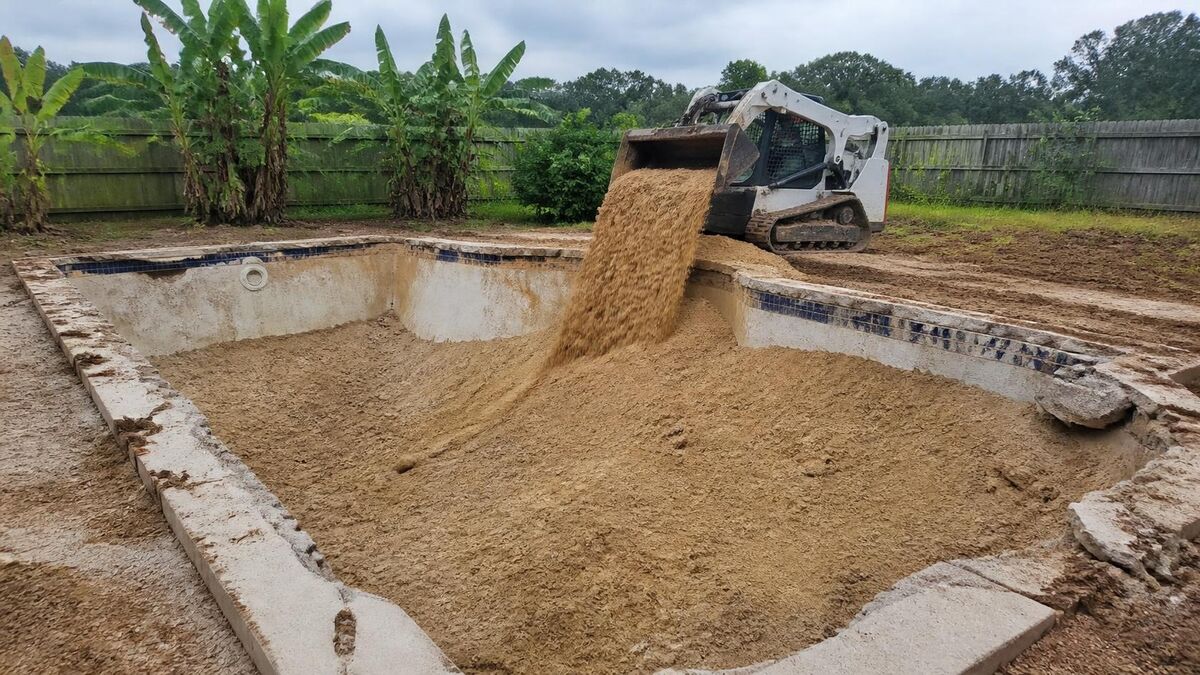
Almost every pool job in the New Orleans area starts with one choice. With the partial route, sometimes described as abandoning or burying the pool, much of the original basin simply stays buried. The contractor breaks off the top portion of the walls, cracks or perforates the floor so water can pass through it, drops the broken pieces into the hole, and then brings in fill and compacts it up to grade. A full removal pulls the entire shell out, hauls it away, and replaces the empty space with fill chosen and placed so the ground can carry weight later.
Partial removal is usually the lighter job: fewer truckloads leave the property and less material comes back in. Full removal is more work, but it leaves nothing buried that a future buyer, surveyor or building official has to wonder about. Which fits depends on your plans for that part of the yard and what your city or parish expects.
Why the buried shell matters more in soft Louisiana ground
Much of Jefferson and Orleans Parish sits on soft clay and organic soils, close to or under sea level, with groundwater that is never far below your feet. That ground compresses slowly under load and moves when it gets wet and dries out again. A buried pool shell behaves differently from the soil around it. The concrete wall stays put while the native ground beside it settles, so a fill-in that looked level on the day the crew left can develop a shallow bowl or a ridge along the old pool outline a couple of seasons later.
Drainage is the other half of the problem. If the floor of an abandoned shell is not broken thoroughly, rain soaking down through the fill has nowhere to go. The old pool becomes a buried bathtub, the fill above it stays saturated, and the lawn turns spongy every time a summer storm parks over the West Bank. A careful partial removal breaks the floor into pieces rather than drilling a handful of holes.
Concrete, fiberglass, vinyl liner and above-ground pools each come apart differently
The construction of the pool sets the method, the equipment and a good share of the effort. A few photos usually settle which kind you have.
- Poured or sprayed concrete (gunite or shotcrete) pools are the heaviest to break. The shell is reinforced with steel, and a hydraulic breaker on an excavator or skid steer is the usual tool. This is where partial versus full removal makes the biggest difference in hauling.
- Fiberglass pools arrive as one molded shell. Crews commonly saw that shell into manageable pieces and hoist them free, and since fiberglass cannot be crushed into reusable base the way concrete can, those pieces usually ride off to be buried at a landfill or dropped at a transfer yard.
- Vinyl liner pools have a thin liner over a sand or cement floor, held by walls of steel, aluminum or polymer panels. The liner is cut out, the wall panels are unbolted or cut, and the metal can usually be scrapped.
- Above-ground pools are the simplest. The water is drained, the liner and frame come apart, and the work that remains is leveling the footprint, filling any dug-out area and dealing with the sand base underneath.
How a typical in-ground pool removal unfolds, step by step
Most residential jobs follow the same basic order.
- Site visit and scope. The contractor checks access to the backyard, what surrounds the pool, the construction type, and whether you want partial or full removal.
- Permit and utility steps. The permit is pulled from the city or the parish, the electrical circuit feeding the pump and lights is shut off and made safe, and Louisiana 811 is called so buried lines are marked before any digging.
- Draining. The water is pumped out to a location the city allows. Where it can go is a local question, so the contractor follows whatever the permit office says about discharge.
- Decking and equipment come out. Coping, the surrounding concrete deck, the diving board, ladders, rails, the pump, the filter and the heater are removed.
- Breaking the shell. For a partial job, the upper walls are broken off and the floor is cracked up thoroughly for drainage. For a full job, the whole shell is broken and loaded out.
- Fill and compaction. Clean fill goes in a layer at a time, each layer compacted before the next is placed, until the hole is back to grade.
- Final grading and inspection. The surface is shaped to shed water away from the house, topsoil goes on top, and the city or parish may want to inspect before closing the permit.
Draining the water without causing a new problem
Thousands of gallons of chlorinated water cannot simply be dumped into the nearest ditch. Where that water may go depends on local rules, and it is the kind of question the permit office answers, not a website.
There is also a practical risk unique to low-lying ground. An empty in-ground pool sitting in a high water table can be pushed upward by the groundwater around it, a failure called floating or popping. That is why breaking and filling usually follow the draining closely here.
Fill and compaction: the part you never see but always live with
The quality of a pool removal shows up years later, in whether the yard stays flat. Two things decide that: what goes into the hole and how it is packed down. Loose dirt dumped in all at once will keep settling for a long time. Fill that is placed in layers and compacted as it rises behaves far more like undisturbed ground.
For a lawn or garden, a contractor might use a different fill than for an area where you plan to put a slab, an addition or a garage. When the future use involves weight, an engineered or select fill and documented compaction testing may be part of the scope, and some buyers and building departments will ask to see that paperwork.
Electrical, plumbing and the pool equipment pad
A pool is wired and plumbed into your house, and those connections have to be dealt with properly instead of being buried. The circuit feeding the pump, the lights and any heater is shut off at the panel and the wiring is made safe, which is a job for an electrician, especially where a subpanel is involved. Supply and return lines are cut and capped. A gas line to a heater is shut off and capped by whoever is qualified to handle gas in your jurisdiction.
The equipment pad can come out with the pool or stay. If you want the surrounding patio or walkway removed as well, that work is covered on the concrete removal page.
Permits, closing out the job and telling a future buyer
In Gretna, New Orleans and Kenner, the city issues the permit. In unincorporated Jefferson Parish, including Marrero, Harvey and Terrytown, the parish handles it. The details differ, but most offices want to know the method, whether the shell stays or goes, and how the hole will be filled. Some inspect the broken floor before fill goes in or the finished grade before closing the permit.
When you sell, Louisiana's property disclosure process asks owners to share what they know about the property, and a buried pool shell is the kind of fact a buyer's inspector or lender may ask about. A fully removed pool with a closed permit is usually a non-issue. A partial removal with a closed permit is generally acceptable for a lawn, but some buyers prefer to see full removal.
What you can put on the old pool site afterward
This is the question that should settle partial versus full removal. If the plan is grass, a vegetable bed, a play area or a lightweight shed, a well-done partial fill usually serves fine. If there is any chance you will want a room addition, a detached garage, a new slab or a raised rebuild on that part of the lot, full removal with engineered fill is the safer route, because a foundation sitting partly over buried concrete and partly over native soil can settle unevenly.
The cost drivers a contractor looks at before pricing a pool
What a contractor weighs during the site visit before pricing:
- Construction type, size and shape, and how thick and how heavily reinforced the shell is.
- Partial or full removal, which changes how much material leaves and how much fill comes in.
- Access from the street and how far material has to be carried or driven across the property.
- Decking, coping, equipment pads and any attached structures that come out with the pool.
- Fill type, whether engineered fill and compaction testing are part of the scope, and final topsoil and grading.
- Electrical and plumbing work to make the pool circuits and lines safe.
- Permit requirements, inspections, and disposal or recycling for broken concrete, metal and fiberglass.
Start with an address and a few photos
If you are ready to be rid of a pool in Gretna, Metairie, Kenner or anywhere nearby, send the address and some photos of the pool, the deck and the route in from the street, and say whether you lean toward partial or full removal. If the house itself or an outbuilding is coming down too, see the house demolition page, and the service areas list shows the communities on both banks.
Pool removal for Gretna — common questions
Should I bury my old pool in place or have the whole shell hauled out?
The answer hinges on how you plan to use that part of the yard afterward. A partial fill-in leaves the lower shell buried and is usually lighter work, and it serves well under a lawn or garden. A complete removal takes out all of the concrete or fiberglass, which matters if you might build there later or expect buyers to ask questions. In the soft, wet soils around New Orleans, a buried shell can also trap water if the floor is not broken thoroughly, so ask how drainage will be handled before choosing the cheaper-looking route.
Will Jefferson Parish want a permit before my backyard pool gets taken out?
Generally yes. Pool removal is earthwork that involves electrical disconnection and filling a large excavation, so the city or parish typically wants to know about it. Gretna and Kenner issue their own permits, while unincorporated areas such as Marrero, Harvey and Terrytown go through Jefferson Parish. The office may ask about the removal method and fill plan and may inspect before closing the permit. Confirm the exact requirements with the permitting office for your address before work starts.
Can a drained in-ground pool float out of the ground?
It can happen. Where the water table is high, as it is across much of Southeast Louisiana, groundwater pressing on an empty shell can lift a concrete or fiberglass pool and crack it. That risk is one reason contractors here try to move from draining to breaking and filling without a long gap. If your pool has sat empty for weeks, or you see the shell sitting higher than the deck, mention that during the site visit so the plan accounts for it.
How long does pool removal take?
The hands-on work at a typical house is often shorter than people expect, but the real schedule depends on the permit office, the weather, the size and construction of the pool, access to the yard, and how many truckloads of fill and debris have to move. Heavy rain can pause the fill and compaction stage, since saturated fill does not pack well. The contractor will lay out the expected sequence after seeing the property; nothing about it can be promised in advance.
Will grass grow over a filled-in pool?
Yes, as long as the top of the fill is finished with a good layer of topsoil and the area is graded to shed water. Grass struggles when the topsoil is too thin or when water ponds over a poorly drained shell. The area may need light topping off in the first year as it settles. Ask whether topsoil, seed or sod are included in the proposal or left to you.
Does a filled-in pool hurt my home's resale value?
A filled-in pool with a closed permit is common and does not have to be a problem, but it is something a buyer's inspector, appraiser or lender may ask about. Buyers who plan to build on that part of the lot sometimes prefer a full removal with fill documentation. Keep the permit, any inspection sign-off and compaction test results in your records, and share what you know through the normal disclosure process when you sell.
What happens to the concrete and equipment from my old pool?
Broken concrete from the shell and deck can often be crushed and recycled into base material, and steel reinforcing, ladders, rails and metal wall panels usually go for scrap. Molded fiberglass, torn vinyl liner and other odds and ends typically get trucked to a landfill that takes them or to a transfer yard. With the partial approach, a portion of the cracked basin is left underground, buried below the new soil. The proposal should say where material is going and whether hauling and disposal are included.
Talk through your site
Start with the address, what needs to come down, and a few photographs of the structure and the access to it.
Related work
House Demolition
Full teardown of a raised or slab house down to a clean lot, with piers or slab removed and utilities cut first.
Garage and Shed Demolition
Detached garages, carports, sheds, camelback add-ons and decks taken down and hauled off cleanly.
Interior Demolition
Storm- and water-damaged rooms, kitchens and baths gutted to the studs, protecting what stays.
Concrete Removal
Sunken driveways, patios, walks, slabs and steps broken up and removed, ready for what comes next.
Across the metro
New Orleans
The city itself: raised shotguns and cottages, historic districts, narrow lots and close neighbors.
Metairie
East Bank suburb with slab ranches, raised rebuilds, backyard pools and drainage canals.
Marrero
West Bank community with postwar houses, carports, sheds and storm-damaged outbuildings.
Kenner
Airport-side East Bank city with ranch houses, slab additions, pools and low-lying streets.