Home › Services
Concrete removal for sunken driveways, cracked patios and old slabs around Gretna
Concrete on this side of Louisiana rarely wears out from traffic. It fails from below. Soft clay and organic soil compress under the weight, rain washes fine material out from under the edges, and a driveway that was level when it was poured ends up tilted toward the house, split into islands and trapping water. Patios drop away from the back step and walks heave around roots. This page covers how that concrete gets broken, lifted out and hauled off, what makes one job harder than another, and how the ground gets left so the next pour, or the new lawn, has a fair chance.
Why concrete cracks and sinks so often in Gretna and New Orleans
Most of the West Bank and the East Bank sits on river sediment and old marsh. That ground keeps consolidating for decades, and it does not do it evenly. One corner of a driveway may rest on a pocket of firmer silt while the middle rides on softer clay, so the slab bends until it snaps. Once a crack opens, rainwater finds it, runs underneath and carries sand away, and the hollow grows every storm season.
Trees add their own pressure. Big roots lift walks and patio edges, then the soil around them dries and shrinks in a hot spell and the panel drops again. Standing water after a big storm can also soften the base and leave voids nobody sees until a section cracks under a parked car.
The concrete homeowners most often ask to have removed
Residential concrete removal around Gretna, Terrytown, Harvey and across the river covers a fairly predictable list of pieces:
- Driveways that have sunk, split into slabs that rock underfoot, or tilted so water runs toward the carport or garage door.
- Back patios that pulled away from the house and now hold a puddle against the foundation after every rain.
- Front and side walks lifted by roots or broken into trip hazards.
- Stoops and front steps that settled away from a raised house and left a gap at the threshold.
- Leftover slabs where a shed, carport or garage once stood. If the building is still there, the garage and shed demolition page covers taking it down first.
- Footings and buried concrete found in a yard where somebody plans to plant, build or regrade.
Lift it, patch it or take it out? How to decide
Not every sunken slab has to go. When a driveway is still in one or two solid pieces and has just dropped, a slab lifting contractor can sometimes pump grout or expanding foam underneath and raise it back toward level. That approach works best on concrete that is intact, not shattered, and on ground that is not still moving fast.
Removal becomes the better call when the concrete is broken into many pieces, when the slab is too thin or too weak to lift without cracking further, when the grade itself is wrong and water will keep running the wrong way, or when you simply want a different layout, a wider drive or green space instead of pavement. Ask whether lifting is worth a try before agreeing to a tear-out.
How the concrete actually gets broken
The breaking method depends on how thick the slab is, how much steel is in it, how close it sits to things that must survive, and how a machine can reach it. Typical approaches:
- Hand demolition with an electric or air-powered breaker and pry bars, used for steps, small pads and anything tight against a house wall or a fence line.
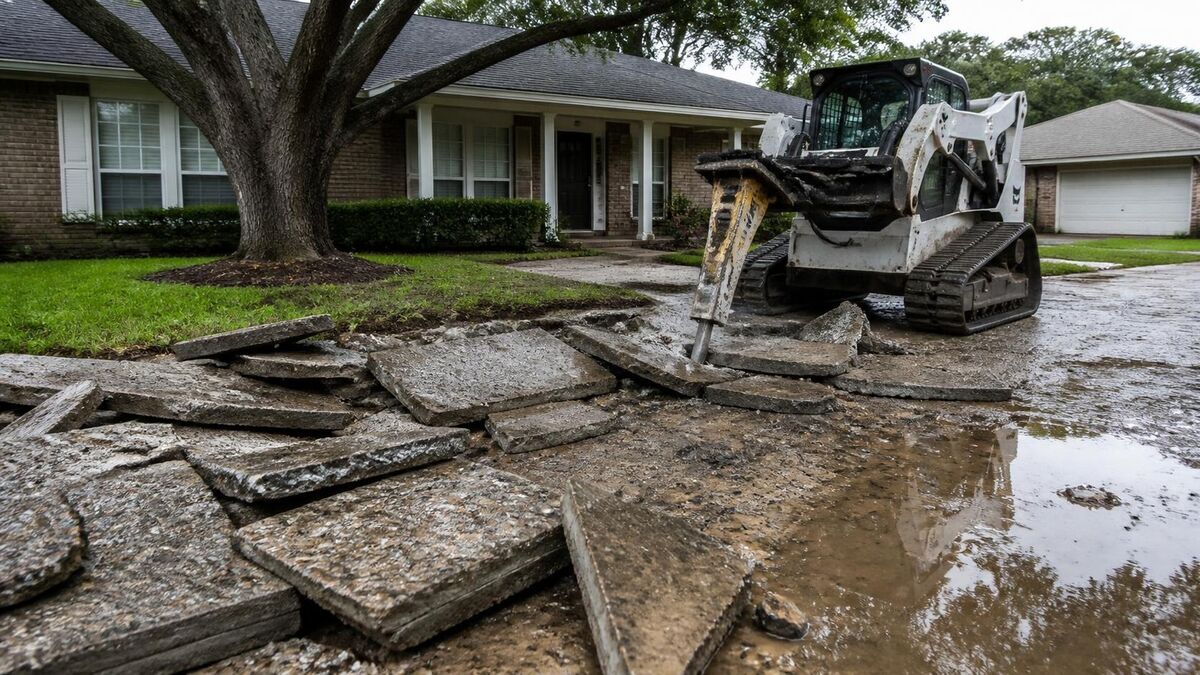
- A compact track loader or skid steer fitted with a hydraulic hammer, the usual choice for an average driveway or patio, followed by the same machine scooping up the rubble.
- A mini excavator with a hammer or a bucket and thumb, which can crack, pry and lift broken pieces and load them straight into a truck or container.
- Saw cutting a slab into manageable panels and lifting them out whole, slower to cut but quieter and less dusty, and useful near glass doors, pools or neighbors who work from home.
Thickness, rebar and wire mesh change the size of the job
Two driveways that look identical from the street can be very different work. Plain concrete with no steel breaks into chunks fairly cleanly. Concrete reinforced with welded wire mesh tends to crack but hang together, so the crew has to cut or shear the mesh to free each piece. Rebar grids are tougher still, with each bar cut free before loading.
Thickness matters just as much. Driveways that were poured thick for heavy trucks, edges that thicken where they meet the street, and slabs that were poured on top of an older slab all take longer to break and add weight to every load. That last one is common here, because a sunken drive often got a fresh layer poured right over it. Some newer slabs also rest on pilings driven into the soft ground; pulling or cutting those belongs with the house demolition work and should come up during the walk-through.
Saw cutting a clean edge and protecting what stays
Many jobs remove only part of the concrete: the broken half of a driveway, the patio but not the walk, the apron but not the slab under the carport. Doing that well takes some care, usually in this order:
- Mark the exact line where removal stops, ideally at an existing joint or a straight cut that the new pour can butt against.
- Saw cut that line with a walk-behind or handheld concrete saw, usually with water to keep the dust down, so breaking does not travel into the section you are keeping.
- Cover nearby windows, doors, AC units and vehicles, and lay plywood or mats where equipment has to cross grass, irrigation lines or a sidewalk.
- Break the concrete working away from the cut line, so the hammer never strikes the edge that stays.
- Check the remaining edge for undermining and loose pieces before anything new is formed against it.
Access, hauling and getting heavy machines across soft yards
Concrete is heavy, and moving it off a residential lot is often the slowest part of the day. A front driveway that opens onto a wide street is easy: equipment works from the slab and loads a dump truck parked at the curb. A back patio behind a raised house with a narrow side yard is a different story. Smaller machines, wheelbarrows or a compact loader may have to shuttle rubble to the front a little at a time.
After a run of rain, a loaded machine can rut a lawn or sink outright, so many contractors lay ground mats or wait for the yard to firm up. Shared driveways and street parking also shape how trucks come and go, so mention them when you ask for a quote.
What happens to busted-up slabs once the trucks roll away
Clean broken concrete is a useful material, not just trash. Most of it heads to a recycling yard where crushers turn it into aggregate that later ends up as road base, fill or drainage stone. Rebar and mesh pulled from the rubble go to a scrap metal buyer. Some jobs use dump trucks, others a roll-off container.
Recyclers prefer loads that are mostly concrete. Large amounts of dirt, roots, asphalt, wood or trash mixed in can push a load toward a landfill or transfer station instead, which usually costs more. Ask where the debris is going; a straight answer tells you a lot about how the job will be run.
The base under the slab deserves a hard look
Once the concrete is off, you can finally see why it failed. Sometimes the answer is obvious: a hollow under the center, sand washed out along one side, a broken drain line or a stump rotting away underneath.
This is the moment to fix the ground rather than repeat the mistake. A contractor may dig out soft spots, remove roots, and bring in crushed stone or another compactable fill, then compact it in layers with a plate compactor or roller. If water was the problem, the grade can be reshaped so the new surface sheds water toward the street or a drain instead of toward the house. Make sure the proposal says whether the base is left as found or rebuilt.
Getting the site ready for a new driveway, patio or lawn
Think about what comes next before the hammer starts. If new concrete is going in, the finishing contractor will want the old material gone, the base at a set height below the finished surface and the edges of anything that stays cleanly cut. Lining up both trades avoids an open, muddy hole sitting through a week of storms.
If you would rather have grass, planting beds or a gravel pad, say so. Turning a former slab into a yard usually means removing more of the old base and bringing in topsoil, because grass struggles in compacted stone. Work in the public right-of-way, such as a driveway apron or a sidewalk panel along the street, may need a permit from the city or parish, and the rules differ depending on whether you are in Gretna, New Orleans or unincorporated Jefferson Parish. If you plan to dig deeper than surface work, Louisiana 811 should mark buried lines first; it is a free call.
What drives the price of concrete removal
There is no fair flat number for concrete removal without seeing the slab. The contractor prices the job after a look, based mostly on these factors:
- Total area and thickness, including any second slab hiding under the first.
- Reinforcement: none, wire mesh, rebar, or a mix.
- Access for equipment and trucks, and how far rubble has to travel to be loaded.
- How much of the concrete stays, and how many saw cuts are needed to protect it.
- Disposal, recycling and how clean the loads will be.
- Base repair, new fill, grading and any topsoil or seed.
- Permits for work near the street and any utility locating or repair.
Ask for a look at your concrete
If you are dealing with a sunken drive, a cracked patio or an old slab you are tired of mowing around, send the address and a few photos and we will pass it to a contractor working the area for a visit. If the yard also holds a pool or a building you want gone, the pool removal page explains that work, and the areas page lists the communities covered across the West Bank and the East Bank.
Concrete removal for sunken driveways — common questions
Can I break up an old concrete patio myself?
A small, thin, unreinforced patio can be broken with a rented breaker and a lot of sweat, but most homeowners underestimate the weight. Even a modest patio produces several truckloads of rubble, and a rental hammer does little against rebar. You also need a way to load and haul it, somewhere that will accept it, and a plan for the base underneath. People often start the job themselves and call a contractor halfway through, which can cost more than hiring it out from the start.
How many days will breaking out and hauling off my old driveway take?
An ordinary single-car or double driveway with decent access is often broken out and hauled in a day or so once work begins. Thick slabs, heavy rebar, a second layer of concrete underneath, tight access or a long carry to the trucks can stretch that. Rain can pause work because wet yards rut and trucks struggle on soft ground. The contractor will give a working estimate after the visit; treat it as a plan, not a promise, especially in storm season.
Is it cheaper to pour new concrete over an old driveway?
Pouring over the old slab skips the removal step, which is why people do it, but it usually carries the old problems forward. Cracks in the slab below tend to show through, the surface ends up higher, which can trap water against a garage door or a threshold, and if the ground under the original slab is still settling, the new layer settles with it. Removing the old concrete lets the contractor fix the base and the drainage so the new pour starts on sound ground.
What happens to tree roots under a driveway when the concrete comes out?
Removal usually exposes the roots that lifted the slab. A contractor can cut small roots back, but large roots close to the trunk of a mature tree are a different matter, because cutting them can weaken or kill the tree. Many owners bring in an arborist before deciding. Options include moving the new edge away from the tree, using a different paving material in that spot, or accepting some future movement. Decide this before the new base goes down.
Do I need a permit to remove concrete from my yard?
Breaking out a patio or a slab fully inside your own lot often does not need a permit, but that depends on where you live, and work that touches the street side is different. Replacing a driveway apron, a curb cut or a public sidewalk panel generally involves the city or parish because that strip is public right-of-way. Gretna, New Orleans and unincorporated Jefferson Parish each handle this through their own offices. A local contractor normally knows which applies and can pull it.
Will removing my driveway fix the water that pools by my house?
Removal alone does not fix drainage, but it gives the chance to do it right. Once the slab is gone, the base can be regraded so the new surface slopes away from the house toward the street, a yard drain or a swale. Sometimes the real cause is a clogged or broken drain line found under the concrete, and that needs repair first. Ask the contractor to look at where water goes during a heavy rain before they set the new grade.
Talk through your site
Start with the address, what needs to come down, and a few photographs of the structure and the access to it.
Related work
House Demolition
Full teardown of a raised or slab house down to a clean lot, with piers or slab removed and utilities cut first.
Garage and Shed Demolition
Detached garages, carports, sheds, camelback add-ons and decks taken down and hauled off cleanly.
Pool Removal
In-ground and above-ground pools broken out or filled in, with fill that holds up in soft, wet ground.
Interior Demolition
Storm- and water-damaged rooms, kitchens and baths gutted to the studs, protecting what stays.
Across the metro
New Orleans
The city itself: raised shotguns and cottages, historic districts, narrow lots and close neighbors.
Metairie
East Bank suburb with slab ranches, raised rebuilds, backyard pools and drainage canals.
Marrero
West Bank community with postwar houses, carports, sheds and storm-damaged outbuildings.
Kenner
Airport-side East Bank city with ranch houses, slab additions, pools and low-lying streets.